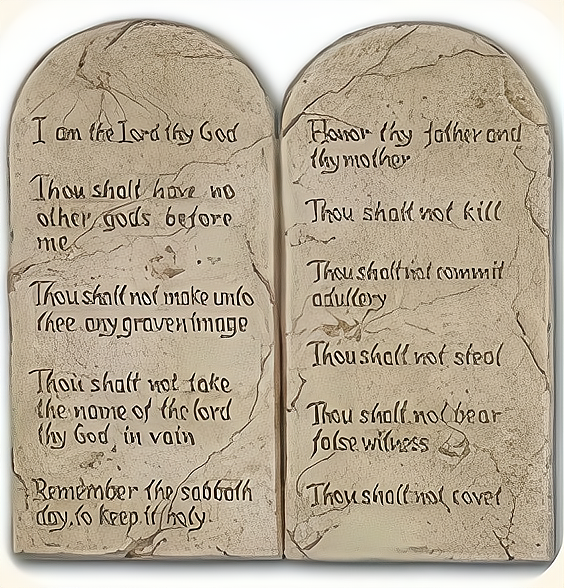
The Ten Commandments
The Ten Commandments & Democracy
Various scholars assert that the Ten Commandments given to Moses by God represent a foundation for democracy. Theologian William Barclay sees the Ten Commandments as "the universal foundation of all things . . . the basic laws of human conduct in society . . ." He adds, "From Israel we Christian peoples inherit that wise and holy code of laws. Our society is founded upon it." (Barclay) He explains:
In order that a mob of people may become a nation they must have a law which they will obey and which will weld them into a community. There can be no community without law. The Ten Commandments are the law without which nationhood is impossible . . . a primary foundational set of principles which are only a beginning, but nonetheless a beginning which was and is absolutely essential.
William Barclay — The Ten Commandments (1973)Author Richard Swift, in his No-nonsense Guide to Democracy, writes that the Ten Commandments represented the earliest form of law and democracy. (Swift)
From Slavery into Self-Administration
Historian Israel Gerber explains the relationship between the Ten Commandments and democracy:
Having escaped from slavery into freedom, the first responsibility of free men was self-administration. Pursuant to the acceptance of the Ten Commandments, all subsequent legislation of a democratic nature develops this principle. Like the American Declaration of Independence, all expressions of the right of the individual to freedom grew out of the revolt of Abraham.
Israel Gerber — Immortal Rebels (1963)According to professor of theology William Brown, the philosopher Baruch Spinoza (1632–1677) likewise affirmed that "the Israelites in the desert acted as in a democracy, because they freely decided to transfer all their rights to God alone and not to any mortal. This 'popular regime' was therefore founded on 'consensus.'" (Brown)
Swedish historian Hugo Valentin (1888–1963) sees the social legislation of the Old Testament and prophetic writings as indications of a "disposition to radicalism," and writes that "Moses was the first to proclaim the rights of man." (Shuldiner)
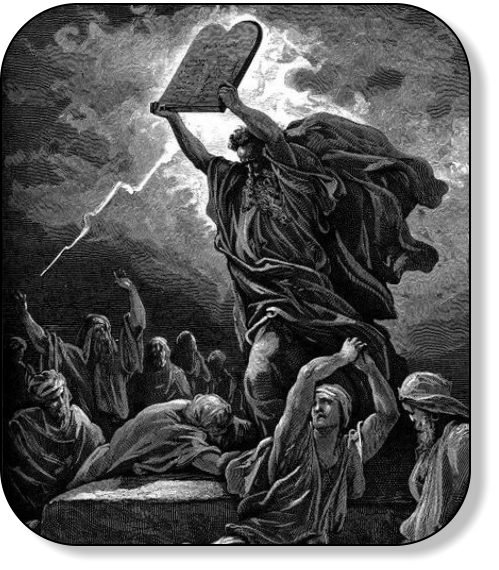
Moses with the Tablets — Gustave Doré
The Liberty Bell & the Law of Moses
The words on the Liberty Bell come directly from the law the Bible presents as given through Moses. In 1751 Isaac Norris, Speaker of the Pennsylvania Assembly, chose a verse from Leviticus for the new State House bell, possibly to mark the fiftieth anniversary of William Penn's 1701 Charter of Privileges. (National Park Service)
Proclaim LIBERTY throughout all the Land unto all the Inhabitants thereof.
Inscription on the Liberty Bell — Leviticus 25:10The verse belongs to the law of the Jubilee, which instructed the Israelites to return land and free slaves every fiftieth year. That meaning was not lost on later Americans: in the nineteenth century, abolitionists adopted the State House bell as a symbol of their cause and gave it the name by which it is now known, the Liberty Bell. Suffragists and civil rights leaders later drew on its inscription as well. (National Park Service)