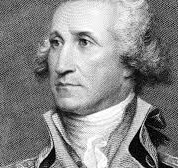
George Washington — Commander & 1st President
George Washington 1st President
George Washington was commander of the Continental Army during the Revolutionary War (1775–1783) and elected first President of the United States (1789–1797). For his contributions to the formation of the United States, he is often referred to as "the father of his country."
Feiler notes that after he died, two thirds of his eulogies referred to him as "America's Moses," one orator concluding that "Washington has been the same to us as Moses was to the Children of Israel." (Feiler, 102) The Reverend William Linn, President of Queen's College (now Rutgers University), spoke of him as an American Moses:
If we compare him with characters in the Sacred Records, he combined the exploits of Moses and Joshua, not only by conducting us safely across the Red Sea, and through the wilderness, but by bringing us into the promised land; like David he conquered an insulting Goliath, and rose to the highest honours from a humble station.
Rev. William Linn — Washington's Eulogy (Hirschfeld)Political leader Robert Hay wrote an article focused on the symbolic relationship between Moses and Washington. Among the "most frequently used texts for Washington eulogies were those verses from Deuteronomy" which describe the death of Moses. Thomas Jefferson wrote, "I felt on his death, with my countrymen, that 'verily a great man hath fallen this day in Israel.'" (Brodie)
Benjamin Franklin Statesman
Benjamin Franklin, one of America's leading politicians and statesmen, often described the difficulties that newly independent American states had in forming a government. To the settlers of Connecticut, he suggested that for their first form of government, until a code of laws could be prepared, they should be governed by "the laws of Moses," as contained in the Old Testament. (Franklin, 504)
In 1788, Franklin described the philosophies he relied on when helping create the United States Constitution:
The Supreme Being had been pleased to nourish up a single family . . . and having rescued them from bondage by many miracles, performed by his servant Moses, he personally delivered to that chosen servant, in presence of the whole nation, a constitution and code of laws for their observance.
Benjamin Franklin (Franklin, 211)Franklin, recognizing the dangers awaiting the new country, writes, "May the God of wisdom, strength, and power, and the Lord of the armies of Israel, inspire us with prudence in this time of danger, take away from us all the seeds of contention and division, and unite the hearts and counsels of all of us . . ." (Franklin, 210)
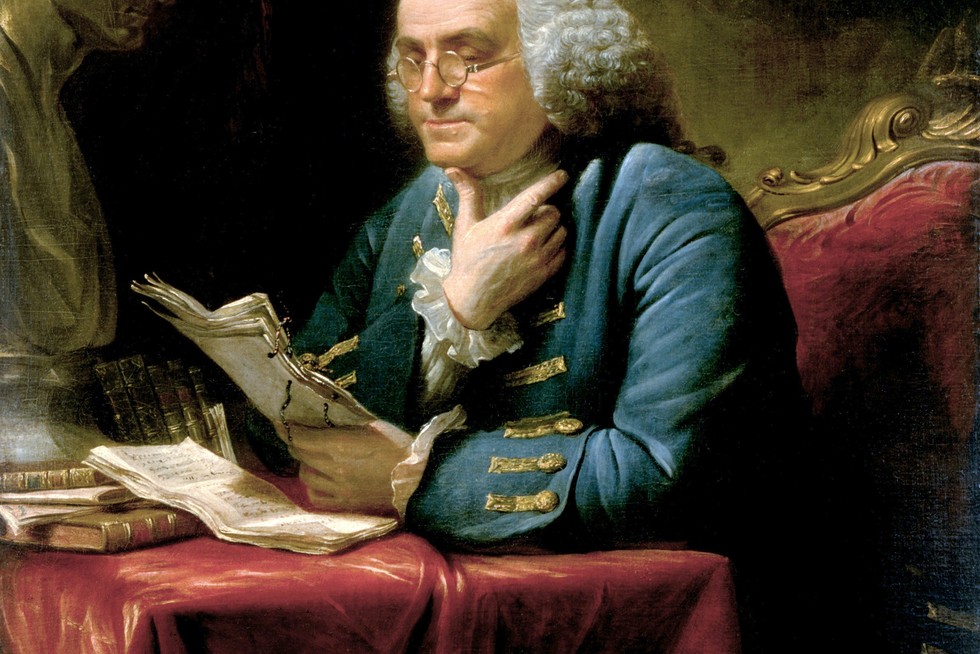
Benjamin Franklin — statesman and Founding Father
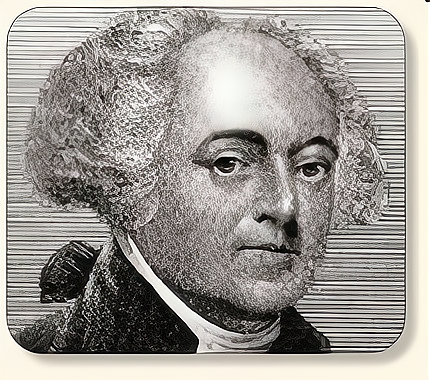
John Adams — 2nd President of the United States
John Adams 2nd President
John Adams, America's 2nd president, compared Moses to the ancient Greeks in explaining why he depended on the laws of Moses when helping establish the American Constitution:
As much as I love, esteem, and admire the Greeks, I believe the Hebrews have done more to enlighten and civilize the world. Moses did more than all their legislators and philosophers.
John Adams (Meacham, 40)As he undertook to help form the Declaration of Independence, he was deeply concerned about accepting a great responsibility. In a personal letter to his wife Abigail, he tried to rationalize his role:
Is it not a saying of Moses, 'Who am I, that I should go in and out before this great people?' When I consider the great events which are passed . . . I feel an awe upon my mind which is not easily described.
John Adams — Letter to Abigail Adams (Ellis)In a private letter to a Dutch dignitary in 1809, Adams expressed his feelings about the sources of democracy: "I will insist that the Hebrews have done more to civilize men than any other nation . . . the doctrine of a supreme, intelligent, wise, almighty sovereign of the universe, which I believe to be the great essential principle of all morality, and consequently of all civilization." (Adams)
Thomas Jefferson 3rd President
Thomas Jefferson (1743–1826) was the third President of the United States (1801–1809), the principal author of the Declaration of Independence (1776), and one of the most influential Founding Fathers. He wrote to the Secretary of War:
I shall need, too, the favor of that Being in whose hands we are, who led our forefathers, as Israel of old, from their native land, and planted them in a country flowing with all the necessaries and comforts of life.
Thomas Jefferson (Jefferson, Political Writings)Jefferson's proposed design for the Great Seal of the United States depicted the Children of Israel in the wilderness, "led by a cloud by day and a pillar of fire by night" — a direct reference to the Exodus narrative. (Meacham, 81)
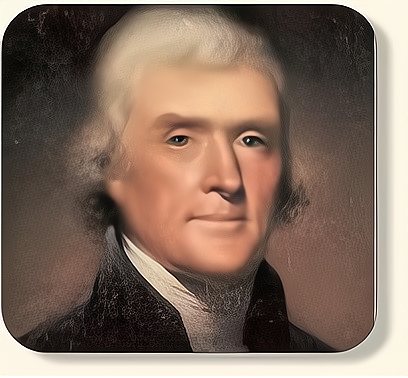
Thomas Jefferson — portrait by Rembrandt Peale