Israel as a Model for Democracy
During this revolutionary period in America's development, countless political and religious leaders used the model of ancient Israel to help create a democratic government. "The Hebrew Commonwealth was explained and held up as an example" in sermons and writings, with the Old Testament as a model. Some writers would state the linkage clearly: "The evidence as to the influence of the Hebrew spirit and political structure of the Hebrew Commonwealth upon the origin of American democracy is definite and direct." (Menorah)
Some religious figures, including rabbi Isaac Mayer Wise, wrote that Moses had "already promulgated principles of democratic liberty and stern justice in an age of general despotism and arbitrary rule." (Meyer)
Samuel Langdon, president of Harvard, explains that "under the conduct of Moses . . . . able men were chosen out of all their tribes, and made captains and rulers of thousands, . . . and acted as judges in matters of common controversy." By creating such divided bodies with the consent of the people, Langdon states, "The government therefore was a proper republic." (Cherry, 94)
Instead of the twelve tribes of Israel, we may substitute the Thirteen colonies and see this application plainly offering itself.
Samuel Langdon — President of Harvard (Cherry, 98)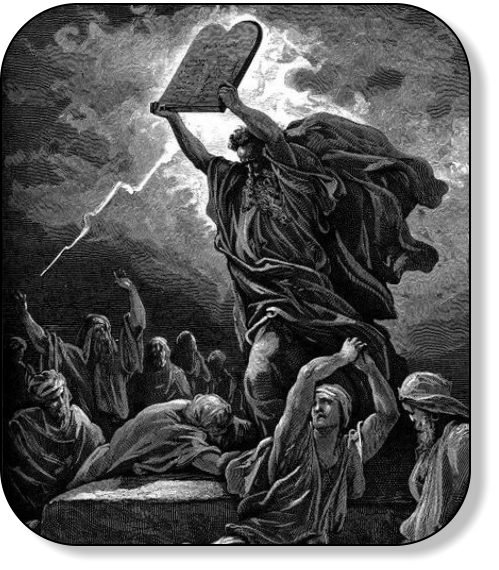
Moses with the Ten Commandments — Gustave Doré
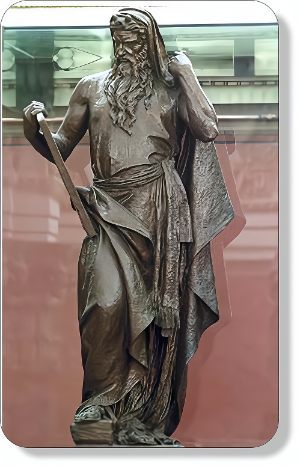
Moses statue — Library of Congress, Washington D.C.
Building a Republic on Ancient Foundations
John McDowell Leavitt, president of Lehigh University, would agree with most conclusions and support the validity of using ancient Israel as a model for democracy:
For five centuries Israel was a democracy. Sovereignty was in the people . . . the Jewish Commonwealth, under the shield of Jehovah, stood for ages, in the whole turbulent and inimical world, a solitary democracy.
John McDowell Leavitt (Leavitt, pp. 12–14)British legal historian Thomas Erskine May, a strong advocate of democracy in Europe and among the authors of the Constitution of the United Kingdom, described ancient Israel as the birthplace of "liberty" and "freedom."
That a race more entitled to our reverence than any people of antiquity should have afforded an example of popular freedom . . . is a conspicuous illustration of the principle that the spirit and intelligence of a people are the foundations of liberty.
Thomas Erskine May — Democracy in Europe (1877)Similar arguments were advanced by Ezra Stiles, president of Yale College, Thomas Paine in his Common Sense, Rev. George Duffield, Samuel West, and many others. The conclusion that democracy should be modeled after the government of ancient Israel "was carried forward in all of the New England colonies by the leading ministers from 1633 until the adoption of the Constitution of the United States." (Menorah)