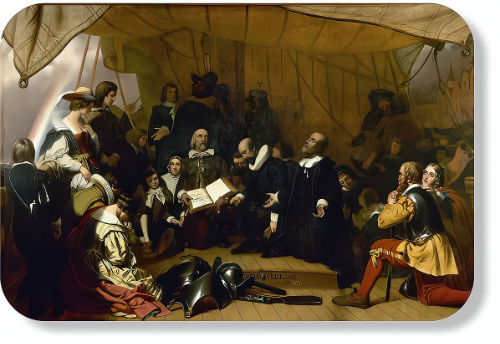
Signing the Mayflower Compact, 1620
Pilgrims & the Moses Parallel
As a result of the Protestant Reformation taking place in Europe beginning in the early 1500s, a large number of Puritans and other Pilgrims left for New England. They eventually founded Plymouth Colony and Massachusetts Bay Colony in the early 1600s.
Author James Russell Lowell notes the similarity of America's founding by the Pilgrims with that of ancient Israel by Moses: "Next to the fugitives whom Moses led out of Egypt, the little shipload of outcasts who landed at Plymouth are destined to influence the future of the world." (Ames)
French author Léon Bloy argues that "Columbus was to Europe what Moses had been to the people of Israel." (Stavans) Historian William G. Dever describes the Pilgrims' own perspective:
We considered ourselves the 'New Israel,' particularly we in America. And for that reason we knew who we were, what we believed in and valued, and what our 'manifest destiny' was.
William G. Dever — HistorianOther writers agree that the Pilgrims were clearly "animated by the true spirit of the Hebrew prophets and law-givers. They walked by the light of the Scriptures, and were resolved to form a Commonwealth in accordance with the social laws and ideas of the Bible." (Moses, Adolph)
John Winthrop & the Arbella
John Winthrop, leader of the Puritans and first governor of the Bay Colony, similarly drew inspiration from Moses. While on board the first Puritan ship, Arbella, as it sailed toward America in 1630, he wrote in his log:
This discourse with that exhortation of Moses, that faithful servant of the Lord in his last farewell to Israel . . . we are commanded this day to love the Lord our God, and to love one another, to walk in his ways and to keep his Commandments and his Ordinance, and his laws . . .
John Winthrop — (Cherry, 40–41)The Moses of Plymouth Colony
Upon settling in America's wilderness, the Pilgrims soon recognized the need for strong leadership to minimize violence and keep the people united. Historian Edward Arber writes, "The leader of a people in a wilderness had need to be a Moses; and if a Moses had not led the people of Plymouth Colony, when this worthy person was their Governor, the people had never with so much unanimity and importunity still called him to lead them." (Arber)
John Carver, the first governor of Plymouth Colony and among the signers of the Mayflower Compact, died just four months after arriving. He later became known as "the Moses of the Pilgrims," and "a symbol of America," as the state of Maine planned to erect a statue in his honor. (Notson)
After many hardships . . . the Pilgrim Fathers first set foot December 1620 upon a bare rock on the bleak coast of Massachusetts Bay, while all around the earth was covered with deep snow . . . Forty-six of the one hundred emigrants were in their graves, nineteen of whom were signers of the Mayflower Compact.
Benson John Lossing — Historian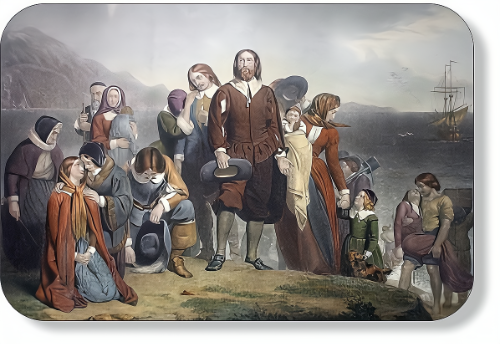
The Pilgrims landing at Plymouth, 1620
Arber also quotes William Bradford, Plymouth's second governor following Carver's death:
Where is the meek and humble spirit of Moses? And of Nehemiah, who reedified the walls of Jerusalem, and the State of Israel?
William Bradford — 2nd Governor, Plymouth Colony (Arber)Bradford spent his later life studying the Hebrew language, in order to have "as direct a connection as possible with the word of God." In his diary, Bradford writes, "I have a longing desire to see with my own eyes, something of that most ancient language and holy tongue . . . as Moses saw the Land of Canaan afar off." (Philbrick)